
Christianity and Artistic Practice: Visualising Faith Through Contemporary Art
The following study explores the connections between the artistic projects of Svetlana Atlavina and the visualisation of spiritual, ethical, and cultural themes within Christianity.
Throughout history, artists have sought ways to represent ideas that cannot be directly seen: faith, hope, memory, forgiveness, love, sacrifice, transformation, and divine presence. Christianity has developed a rich visual language through icons, illuminated manuscripts, stained glass, sculpture, architecture, and ritual objects, enabling abstract spiritual concepts to become accessible through material forms.
Similarly, contemporary artists often investigate invisible aspects of human experience through images, objects, spaces, sound, participation, and new technologies. While not all artworks are explicitly religious, many engage with questions that have long occupied Christian thought: How do we remember? How do we care for one another? How do we find meaning in suffering? How do we encounter the unseen? What does it mean to belong to a community? How can transformation take place?
This study examines selected projects by Svetlana Atlavina and proposes possible metaphorical connections to Christian teachings, biblical narratives, and theological concepts. These interpretations are not intended as definitive readings but as pathways for reflection. They demonstrate how contemporary artistic practice can engage with enduring questions of faith and human experience.
The page is intended to support students, educators, artists, and researchers who are interested in representing beliefs, cultural stories, spiritual values, and ethical ideas through visual art. By examining the relationship between artistic processes and Christian themes, it offers examples of how abstract concepts may be translated into material, visual, participatory, and digital forms.
The projects discussed include explorations of memory, community, healing, pilgrimage, hospitality, embodiment, prayer, creation, and transformation. Together they reveal how contemporary art can create spaces where spiritual questions may be encountered, contemplated, and shared.
How to Use This Study
Each project is presented through four lenses:
Artistic Theme
The central question or concern explored by the artwork.
Christian Metaphor
A symbolic connection between the project and Christian thought.
Biblical Resonance
Relevant biblical stories, teachings, or passages that illuminate the work.
Visual Strategy
How abstract ideas such as faith, hope, redemption, sacrifice, or divine presence are translated into visual, material, spatial, or participatory forms.
This approach encourages students not simply to illustrate biblical stories, but to think more deeply about how art can communicate spiritual meaning through metaphor, process, material, and experience. Just as Christian art has evolved across centuries and cultures, contemporary artists continue to find new ways of making invisible ideas visible.
Projects Included
All is One (2024 - present)
Contested Space (2014 - 2018)
My Mother and I (2019 - present)
Lines of Reproduction (2020)
SVETTA (2020 - 2022)
Bridge (2023 - 2024)
Clay and Augmented Reality (CAR) (2023 - present)
Nature on Sunrise (2025–present)
Lines of Prayer (2025–present)
Together, these projects form a journey through questions of memory, relationship, care, embodiment, and transcendence, revealing how contemporary artistic practice can become a site for exploring the enduring themes of Christianity in new and unexpected ways.
Artists often work on several projects simultaneously, allowing them to think, experiment, and explore new directions. Ideas developed in one project can influence another, creating connections and enriching an ongoing artistic practice. Through this process, different themes, materials, and experiences are fused together, leading to new insights and creative possibilities.
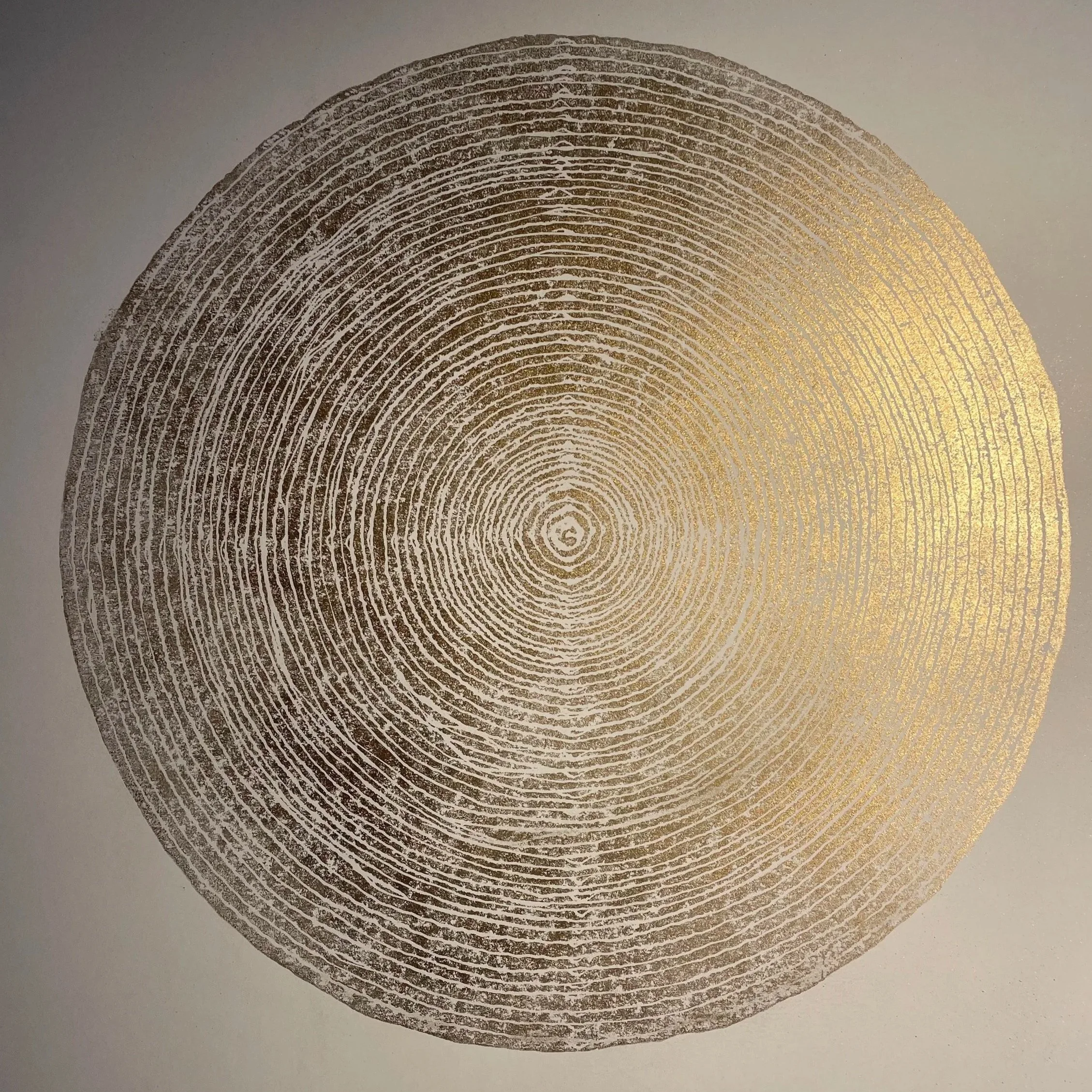
Life 1, part of the project All is One.
Life I (Psalm 51) / All is One (2024)
Artwork: Life I
Medium: Hand-pulled linocut print with gold ink
Size: 70 × 50 cm
Edition: 10
Artistic Theme
Life I explores the invisible connections between human beings and the forces that sustain life. Developed during the Christian artists' residency Look! This is My Faith (2024), the work emerged from an investigation into how people communicate beyond words, through eye contact, presence, emotion, and what might be described as a person's "spirit state."
The project asks how unseen aspects of existence can be made visible. Inspired by the continuous rhythm of the human heartbeat and the subtle exchanges that occur between individuals, Life I reflects on interconnectedness, presence, and the mystery of life itself.
Christian Metaphor
Within a Christian context, Life I can be understood as a meditation on the relationship between the visible and the invisible. The work reflects the Christian belief that human life is sustained not only by physical processes but also by spiritual realities that cannot be directly observed.
The fifty gold lines represent both the rhythm of the living heart and the ongoing movement of the human spirit. Just as Brownian Motion reveals the presence of unseen activity beneath apparent stillness, Christian theology speaks of the action of the Holy Spirit, whose presence is known through its effects rather than its visibility.
The circular composition suggests unity within diversity. Individual lines appear distinct yet form a single interconnected whole, echoing the Christian understanding of humanity as one body composed of many members. The project's title, All is One, resonates with the idea that creation is interconnected through its relationship with God and with one another.
The project also resonates with the Christian understanding of a prayer as a Communion Chalice. Just as individual lines join to create a larger image, individual prayers become part of a wider spiritual community extending across generations, diversive backgrounds, and levels of faith. The artwork reflects on the belief that prayer connects people not only to God but also to one another. The Christian monastic practice often initiate reading the whole Book of Prayer in one day, dividing Psalms in groups of 20 Katismas and between participants, in this way, the 150 Psalms could be read in one day.
In Orthodox Christianity, the Communion of Bread and Wine is given with one spoon to the Church Congregation, symbolising Onness in the Body of Christ, uniting the members through the Communion Chalice.
Biblical Resonance
The work is based on Psalm 51 (Psalm 50 in the Septuagint tradition), one of the most profound prayers of repentance and renewal in the Book of Psalms It is one of the most frequently prayed and reflected upon texts in Christian tradition. It has been recited in monastic communities, incorporated into liturgies, set to music, and used in private devotion for centuries.
Several verses are particularly relevant to Lines of Prayer:
"Let me hear joy and gladness; let the bones you have crushed rejoice." Psalm 51:8
It speaks about hearing, joy, restoration, the body, and transformation after brokenness. All themes resonate with sound, memory, prayer, embodiment, and healing. The verse is remarkable because it speaks not first about seeing, but about hearing. The Psalmist asks for the capacity to hear differently. After a period of grief, guilt, or separation, the prayer is not simply for circumstances to change, but for the senses themselves to be renewed. Hearing becomes a metaphor for spiritual receptivity, the ability to perceive hope, grace, and ‘the new possibility’ once again. This theme resonates strongly with artistic practice, which often explores forms of communication that exist beyond ordinary language. Just as vibrations of heart travel through the body before they are consciously understood, prayer may operate beneath the level of words.
"Let the bones you have crushed rejoice." In biblical language, bones often symbolise the deepest structure of a person. Their strength, identity, and very being. The image acknowledges experiences of suffering, vulnerability, and brokenness. Yet the verse does not end with destruction. The bones are invited to rejoice. This movement from brokenness to rejoicing parallels the process of printmaking itself. The printing block is cut, carved, and physically altered. Material is removed. Through this process of incision and transformation, a new image becomes possible. What appears at first to be an act of loss becomes the condition for creation. For Lines of Prayer, the verse suggests that spiritual renewal is not the erasure of past experiences but their transformation. The carved marks remain visible as evidence of labour and change. Similarly, the Psalm proposes that healing does not require forgetting suffering; rather, suffering may become integrated into a renewed understanding of life.
The verse also connects to the project's use of gold. In Christian art, gold often signifies divine presence and transfiguration. The gold lines do not conceal the marks created through carving but illuminate them. They suggest that joy and gladness emerge not from perfection but from a renewed relationship with what has been wounded.
"Create in me a clean heart, O God, and renew a right spirit within me." Psalm 51:10
This verse focus on transformation rather than outward appearance and emphasis on the condition of the heart which seeks to visualise and show invisible aspects of human existence. The work may also be connected to biblical descriptions of the Holy Spirit as breath and wind:
"The wind blows where it wishes, and you hear its sound, but you do not know where it comes from or where it goes." John 3:8
Like Brownian Motion, the movement of the Spirit is perceived through its effects rather than directly observed. The artwork invites contemplation of this mystery. A further resonance can be found in St Paul's description of the Church:
"For just as the body is one and has many members... so it is with Christ." 1 Corinthians 12:12
The many gold lines forming a unified image become a visual metaphor for a community bound together through relationships that extend beyond the individual self.
Visual Strategy
Rather than illustrating a biblical story directly, Life I translates spiritual ideas into visual form through abstraction. The fifty gold lines correspond to Psalm 51 and simultaneously evoke heart rhythms, vibrations, energy fields, pathways of movement, and interconnected lives. Their concentrated arrangement creates a sense of motion while retaining stillness, encouraging viewers to contemplate the tension between order and apparent randomness. The circular structure symbolises wholeness, eternity, continuity, and unity. It invites reflection on how individual experiences participate in larger patterns that extend beyond immediate perception. The use of gold ink references a long tradition of Christian art in which gold signifies divine light, sacred presence, and the eternal. Rather than depicting God directly, the gold surface suggests a reality that transcends the material world while remaining present within it.
The hand-pulled printmaking process is also significant. Each impression is created through physical labour, pressure, and repetition, reflecting the embodied nature of prayer and contemplation. Through simple visual means—line, rhythm, repetition, and gold—the artwork offers a contemporary way of visualising faith, spiritual presence, interconnectedness, and the mystery of life itself.
Key Concepts: Psalm 51 • Heart and Spirit • Brownian Motion • Divine Presence • Interconnectedness • Holy Spirit • Unity and Diversity • Transformation • Contemporary Christian Art • Abstraction and Faith.
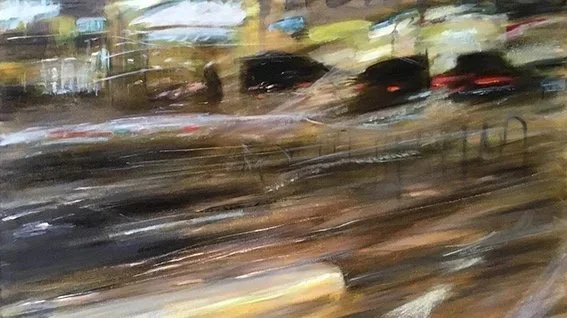
Slow Shutter, part of the Contested Space project.
Slow Shutter / Contested Space
Artwork: Slow Shutter
Medium: Oil painting.
Size: 102 cm x 127 cm
The Contested Space project is particularly interesting because its Christian connection is not immediately obvious. It is not a project about churches, prayer, or scripture. Yet beneath the surface it deals with questions that Christianity has wrestled with for centuries: how human beings live together, how we treat strangers, vulnerability, conflict, and the value of a single life.
The strongest connection may actually be the road from Jerusalem to Jericho in the Parable of the Good Samaritan.
But because it asks a timeless question: How do we travel alongside one another without forgetting that every person on the road carries a life as precious as our own?
Artistic Theme
The project explores London's streets as a place where pedestrians, cyclists, and drivers compete for limited space, negotiating risk, movement, care, impatience, and survival.
Christian Metaphor 1: The Road as Life
Throughout Christianity, the road is one of the most powerful metaphors.
Christ does not say: "I am the destination."
He says: "I am the way." (John 14:6) That is also the main principle of the art processes that focus on acts of creation slowly developing the artwork.
The cyclists, drivers, and pedestrians are all travellers. The city becomes a contemporary pilgrimage route. People are moving toward work, family, hospitals, homes, and unknown destinations. In this reading:
London street = human life
Traffic = worldly struggle
Journey = pilgrimage
Christian Metaphor 2: The Good Samaritan
The project was inspired partly by accidents, vulnerability, ambulances, paramedics, and stories of injured cyclists. The central question becomes:
When another person falls on the road, what do we do? This is precisely the question of the Parable of the Good Samaritan.
The Christian reading shifts attention from traffic systems to human response.
Who stops? Who passes by? Who notices? Who cares?
Your project does not preach an answer, but it places viewers in the position of asking the question.
Christian Metaphor 3: Contest and The Wheel of Love
The title itself is fascinating. Contested Space can be read as the opposite of Christian communion. Yet human beings often transform shared space into contested space. The project reveals what happens on the road: competition, impatience, fear and self-preservation. The street becomes a miniature image of humanity. Everyone wants to arrive first. Everyone believes their route matters most. Yet everyone remains dependent on others.
Christian theology imagines creation as a shared space full of mutual support and love. Early Christian writing by Dorotheos of Gaza (6 AD) employed the geometry of a spoke wheel to describe Christian love. It is one of humanity's oldest visual expressions of the relationship. In the text, the wheel description unites the centre - God with the outside world, presented by the circumference. All spikes - people's lives, converge towards the centre. The closer individuals approach God, the closer they approach each other. As they draw near to each other, they draw near to God.
The first engineered wheel for transportation known to exists, is dated around 2000 BCE. Within Contested Space, roads become contemporary versions of the circumference. Drivers, cyclists and pedestrians move along intersecting paths. Traffic lights, crossings, signs and road markings act as collective agreements - central point - designed to maintain harmony between moves.
The bicycle wheel therefore becomes more than a mechanical object. It represents a visual reminder of an ancient structure of relationship.
Every spoke depends on the centre. Every spoke depends on every other spoke.
The strength of the wheel lies not in any individual element but in their mutual tension and cooperation.
Christian Metaphor 4: Vulnerability
The review by the Revd Dr Rachel Nichols notes vulnerability, darkness, rain, injury, and dislocation. Christianity places vulnerability at the centre of its story. Not power. Not speed. Not efficiency. The cyclist is vulnerable. The pedestrian is vulnerable. Even the driver is vulnerable facing a pushchair with a child. We live on streets almost 1/5 of the day. The project quietly asks:
What kind of society do we build when we forget the vulnerable?
Christian Metaphor 5: The City and the Heavenly City
Saint Augustine have contrasted the earthly city and the heavenly city in his book City of God. London is not an ideal one as many other cities around the world, but many groups would desire to live in organised around love, communial service, humility and peace city. These is connected how people live together in shared environments as a road, a city, a church, or a community. The project Contested Space draws on rethinking the behavioural patterns within the daily interactions organised by self-interest, competition, power, status, possession and domination. London being a noisy, dangerous, crowded, and fragmented city with extreme poverty and wealth sharing the dame pavements, yet within it there are many moments of care, patience, and compassion. The project could be understood as an attempt to observe community that trying to live together inside an imperfect city.
Possible Theological Interpretation
If there an exhibition at the church, the introduction paragraph for an exhibition catalogue, would be:
Contested Space explores the streets of London as a contemporary metaphor for human coexistence. Pedestrians, cyclists and drivers navigate a shared environment marked by vulnerability, competition and interdependence. Viewed through a Christian lens, the road becomes a place of pilgrimage, where encounters with strangers reveal questions of responsibility, compassion and care. The project reflects on how shared spaces may become contested, yet also hold the possibility of mutual recognition and community.
Timeless question remains:
How do we travel alongside one another without forgetting that every person on the road carries a life as precious as our own?
That question sits at the heart of both Contested Space and Christian ethics.
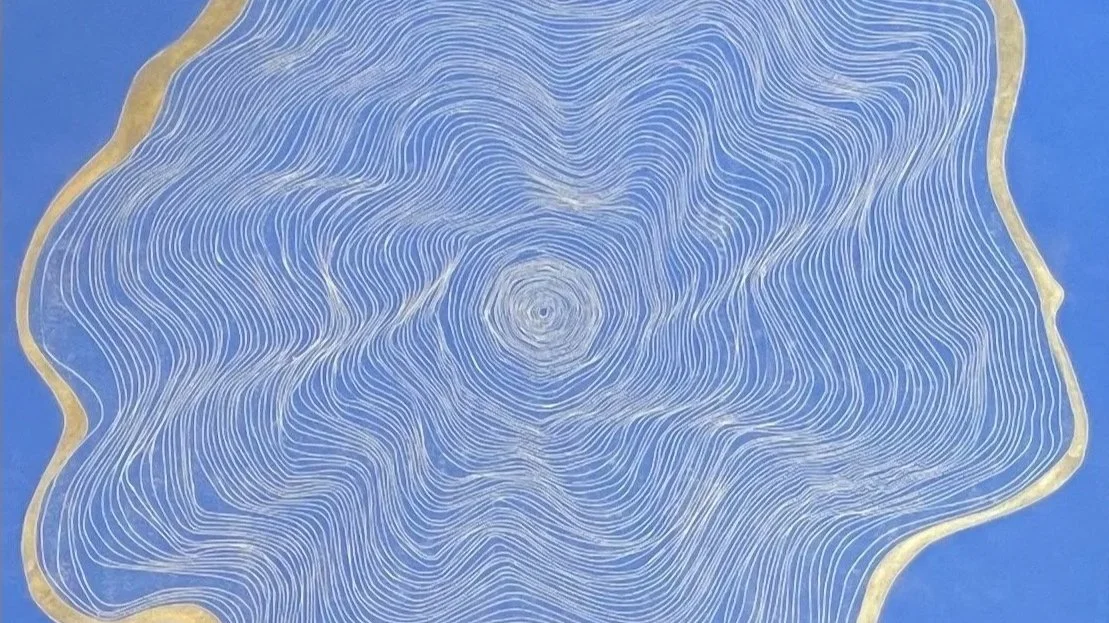
Kathisma 20, part of the Lines of Prayer project.
Lines of Prayer (2025–Present)
Project: Lines of Prayer
Medium: Relief printmaking, linocut, gold and coloured inks on paper
Ongoing series exploring Psalms, prayer, memory, and contemplative mark-making
Artistic Theme
Lines of Prayer explores prayer as both a spiritual practice and a physical act of making. The project began with a simple question:
Can a prayer become visible?
Drawing inspiration from the Book of Psalms, the series transforms sacred texts into hand-carved lines, circles, and patterns. Rather than illustrating biblical narratives, the work seeks to visualise the movement of prayer itself: it’s rhythm, repetition, persistence, and capacity to accompany people through joy, grief, uncertainty, and hope.
Many of the prints are created by inscribing entire psalms into continuous lines (Psalms: 91(90), 118(119), Kathisma 20. Individual words become unreadable, yet remain physically present within the image. The process reflects how prayer often operates beyond conscious thought, becoming part of the body's memory through repetition.
The project also investigates the relationship between individual and collective experience. Psalms written thousands of years ago continue to be prayed by people across different cultures, languages, and generations. Through printmaking, Lines of Prayer explores how personal faith becomes connected to a wider community of voices across time. Whenever is suitable, I ask strangers, friends, colleagues, patients and street walkers about their meaningful psalm or verses from scriptures.
Christian Metaphor of the Project
Within a Christian context, the carved line becomes a metaphor for the spiritual journey.
A prayer rarely follows a straight path. It circles, returns, hesitates, repeats, and continues. The engraved lines reflect this movement, suggesting pilgrimage, contemplation, and perseverance. Each mark records both a physical action and an act of attention, transforming the printmaking process into a form of embodied prayer. Heartbeats are exsited evidence of one life but could be heared only when one is next to the person, or with a stetoscope and other technological means at the hospitals. However, these beats shaping the experiences, give love, compassion and care.
The circular forms and symbolic representation of meanings (as in Psalm 139) frequently appear throughout the series and can be understood as symbols of eternity, divine wholeness, and the continuous presence of God. Unlike a line with a clear beginning and end, a circle or spiral suggests ongoing relationship, ascending rather than completion.
The repeated carving of circles and symbols on the printing block mirror the way prayer gradually shapes the heart. What begins as a word, sentence and the language becomes habit, memory, and ultimately a way of being.
Biblical Resonance
The primary source for the project is the Book of Psalms, for both Judaism and Christianity.
The Psalms express the full range of human experience: praise, lament, thanksgiving, fear, repentance, trust, wonder, and longing. They provide language for spiritual moments when ordinary words seem insufficient, similar to the connection between the Mother and the Child. Below is examples of a few visualised Psalm and references to the Book of Psalms.
Psalm 51 — repentance and renewal
Psalm 139 — God's intimate knowledge of creation
Psalm 23 — guidance and trust
Psalm 150 — praise through all creation
Psalm 121 — pilgrimage and protection
Psalm 85 — restoration, mercy, reconciliation, and the renewal of the land
Psalm 86 — prayer for guidance, mercy, protection, and wholehearted devotion.
The project also reflects the biblical tradition of meditation:
"His delight is in the law of the Lord, and on his law he meditates day and night." Psalm 1:2
The repetitive process of carving and printing parallels this contemplative practice. As lines inscribed repeatedly into the block, observing becomes reflection and reflection becomes embodied action connetced to memory of words that became images.
A further resonance may be found in Paul's teaching:
"Pray without ceasing." 1 Thessalonians 5:17
The continuous lines within the prints visually suggest this ongoing state of prayer, where spiritual attention becomes woven into everyday life.
"Create in me a clean heart, O God, and renew a right spirit within me." Psalm 51:10 This verse lies at the heart of the project's investigation into the relationship between external actions and internal states. The work asks how a renewed spirit might be represented visually.
"Open my lips, O Lord, and my mouth shall proclaim your praise." Psalm 51:15. The project transforms spoken prayer into visual language. Words that would ordinarily be spoken, sung, or recited become engraved marks and physical traces.
"The sacrifice acceptable to God is a broken spirit; a broken and contrite heart." Psalm 51:17 This verse resonates with the physical process of printmaking itself. Cutting, carving, and removing material become symbolic acts that reflect the Psalm's understanding of humility and openness to transformation. Psalm 51 also connects to broader Christian themes of forgiveness, redemption, and resurrection. The movement of the Psalm from confession to renewal mirrors the wider Christian narrative in which death gives way to new life.
Artistic Theme
Psalm 51 forms one of the central foundations of Lines of Prayer. Traditionally attributed to King David after his confrontation with the prophet Nathan, the Psalm is a profound meditation on repentance, self-examination, and spiritual renewal.
Rather than focusing on external actions, the Psalm turns inward toward the condition of the heart. This concern with inner transformation resonates strongly with the project's exploration of prayer as a gradual and ongoing process. The carving of lines into the printing block mirrors the reflective nature of the Psalm itself. Each mark becomes a record of attention, repetition, and contemplation.
The project approaches Psalm 51 not as a historical text but as a living prayer that continues to speak to contemporary experiences of vulnerability, regret, forgiveness, healing, and hope. The work asks how invisible processes of spiritual change might be translated into visible forms.
Psalm 85 holds a special significance within the project because it visualises relationships between divine and human realities, speaks about restoration, mercy, reconciliation, peace, and the meeting of heaven and earth - themes that resonate strongly with Lines of Prayer.
This Psalm also speaks of restoration after a period of separation and contains one of the most poetic descriptions of spiritual reconciliation in Scripture:
"Mercy and truth have met together; righteousness and peace have kissed each other." Psalm 85:10
This verse has inspired artists, theologians, and writers for centuries. It presents spiritual qualities as living forces capable of encounter and relationship. Within Lines of Prayer, the intersecting lines, circles, and pathways may be understood as visual reflections of such encounters, where seemingly separate realities meet and become united. Particularly, the meeting of mercy and truth, righteousness and peace represent concepts through movements of line and rhythm. Individual marks cross, converge, separate, and reunite, creating visual relationships that mirror the Psalm's vision of harmony. The resulting compositions invite viewers to contemplate how spiritual realities may become visible through connection, balance, and encounter.
Psalm 86 is a prayer for guidance, mercy, protection, and wholehearted devotion.
"Teach me your way, O Lord, that I may walk in your truth; unite my heart to fear your name." Psalm 86:11
The prayer for a united heart resonates with the project's exploration of interconnectedness, wholeness. The visual movement of the prints can be understood as a search for direction, reflecting the Psalmist's desire to walk faithfully while remaining open to divine guidance.
Christian Metaphor
Within a Christian reading of Psalm 51 is often understood as a journey from fragmentation toward restoration.
The carved line becomes a metaphor for this journey. As the carving tool removes material from the block, a new image gradually emerges. This process parallels the spiritual movement described in the Psalm, where repentance is not understood as punishment but as the clearing away of obstacles that prevent a person from drawing closer to God.
The repeated lines within the prints may be seen as traces of prayer itself. Like the repeated petitions of the Psalm, they express persistence rather than perfection. The image develops slowly through countless individual gestures, reflecting the Christian understanding that spiritual growth occurs through continual practice rather than sudden transformation.
The circular forms that appear throughout the series can also be interpreted through Psalm 51 as symbols of renewal and return. The prayer repeatedly moves back toward God, suggesting that faith is not a straight path but an ongoing process of returning, remembering, and beginning again.
Gold plays an important role in this metaphorical reading. Traditionally associated with divine light, it suggests the possibility of grace emerging from human imperfection. The gold lines do not conceal flaws but illuminate them, reflecting the Christian belief that transformation often begins with honest self-recognition.
Visual Strategy
Lines of Prayer employs abstraction to communicate spiritual ideas rather than depicting biblical scenes.
The primary visual element is the line. Each line is formed through the slow and deliberate carving of text into a linoleum block. The resulting marks simultaneously function as language, drawing, and record of action. Viewers may not be able to read every word, yet the presence of the text remains embedded within the image.
The project is also informed by the imagery of Psalm 85, Repetition plays a central role. Repeated marks echo repeated prayers, liturgical chants, breathing patterns, and devotional practices. Through accumulation, simple marks become fields of visual energy.
Circular compositions frequently appear throughout the series. These forms suggest eternity, unity, cycles of life, and the unbroken nature of divine presence. They also reference the gathering of communities around shared beliefs and practices.
The use of gold ink draws upon a long tradition within Christian art. In icons, illuminated manuscripts, and sacred objects, gold signifies divine light and transcendence. Within Lines of Prayer, gold functions not as decoration but as a visual reminder of the sacred dimensions embedded within ordinary human experience.
The hand-pulled printing process is equally significant. Each impression carries subtle variations, reflecting the uniqueness of individual acts of prayer while remaining connected to a larger pattern. Through line, repetition, rhythm, and materiality, the project translates invisible spiritual practices into visible form.
Educational Reflection
Lines of Prayer offers students an example of how contemporary artists can engage with Christianity without relying on literal illustration. Instead of depicting biblical events directly, the project translates abstract ideas such as prayer, divine presence, memory, devotion, and spiritual transformation into visual forms. It demonstrates how materials, processes, repetition, and symbolism can communicate faith through experience encouraging new approaches to the representation of religious belief in contemporary art.
The project provides students with an excellent example of how abstract theological concepts can be translated into visual language. Ideas such as mercy, truth, peace, justice, forgiveness, and reconciliation are difficult to depict literally. Lines of Prayer is similar to a guidance on how artists can explore themes through composition, movement, repetition, material choice, and symbolism, allowing viewers to experience these concepts. Psalm 85 is one of the clearest biblical examples of abstract virtues being visualised as relationships.
Key Concepts: Prayer • Psalms • Contemplation • Pilgrimage • Repetition • Divine Presence • Community • Embodied Faith • Sacred Text • Printmaking • Memory • Eternity • Christian Visual Culture
Visualisation of the Book of Psalms in Short
The visual language of Lines of Prayer translates the themes of Psalms into abstraction rather than illustration.
The hand-carved lines function as visual equivalents of repeated prayer. Each line records a physical gesture, much like each verse of the Psalm records a movement of thought and emotion. The accumulation of marks creates a sense of rhythm that echoes breathing, chanting, or meditative repetition.
The process of relief printmaking itself becomes significant. The image emerges through removal rather than addition. Material is cut away from the surface of the block in order to reveal the final print. This mirrors the spiritual movement described in Psalm 51, where renewal is achieved not through acquisition but through purification and transformation.
Circular compositions reinforce themes of return, renewal, and continuity. They suggest that repentance is not an endpoint but part of an ongoing cycle of growth and spiritual development.
The use of gold ink introduces another layer of meaning. In Christian visual culture, gold often signifies divine presence, sacred light, and eternity. Within Lines of Prayer, the gold lines transform a deeply personal prayer into a reflection on the possibility of grace. They invite viewers to contemplate how beauty, healing, and spiritual insight may emerge from experiences of vulnerability and self-examination.
Rather than depicting David, biblical events, or symbolic objects, the work embodies the Psalm through process, repetition, rhythm, materiality, and light. In doing so, it offers a contemporary visual interpretation of one of Hebrew’s and Christianity's most enduring prayers for renewal.
The description of other projects will follow soon.